2021-10-20
“The Big 5 Financial Groups Join Hands to Replace Visa and MasterCard”
Global payments and remittances possible without credit cards or foreign-currency exchange
Transferred to Hana Bank’s fintech subsidiary ‘GLN International’
Overseas service coverage to expand from ‘8 countries → more than 20 countries’
“Lower fees and faster settlement, greater benefits for consumers and merchants”
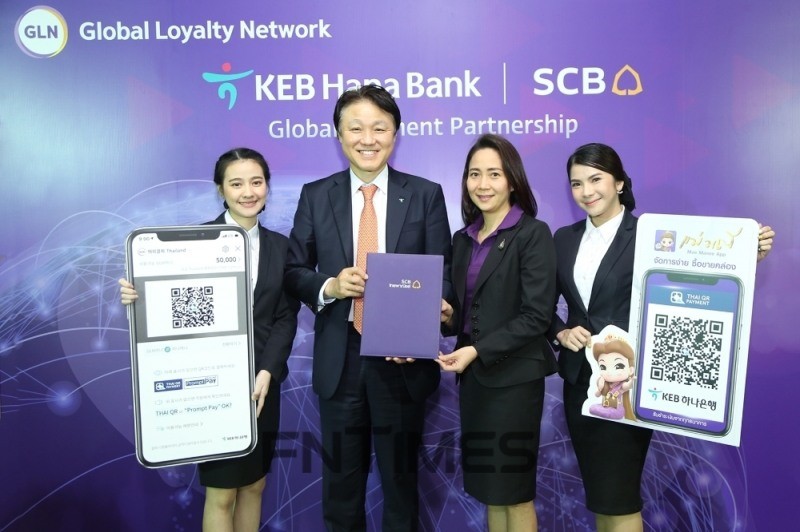
(From second on the left) Han Jun-seong, CEO of GLN (Global Loyalty Network) (former Executive Vice President and Head of Group Digital at Hana Financial Group), and Auraratana Jutimitta, Executive Vice President of Retail Banking at Siam Commercial Bank, pose for a commemorative photo after signing a partnership for GLN payments in Thailand in 2019. /Photo=Hana Financial GroupView enlarged image[Korea Financial Newspaper, Reporter Lim Ji-yoon] Hana Bank has begun building an ‘integrated global payment network for financial institutions’ in collaboration with the Big 5 financial holding groups (KB Kookmin, Shinhan, Hana, Woori, and NH NongHyup).
Put simply, just as Bank of America in the U.S. launched a credit card called ‘BankAmericard’ in 1958, which became hugely popular and evolved into today’s Visa card, the goal is to create a ‘consumer-centered’ payment network usable without border restrictions.
Hana Bank has created a new entity to lead the GLN business so it can build networks with various domestic and overseas operators, including the Big 5 financial groups. Rather than promoting the Hana Bank name, the plan is to expand domestic and global networks under a new name, including participation from the Big 5.
◇ “The spin-off will enhance services at home and abroad”
According to the financial industry on the 20th, GLN (Global Loyalty Network), the global payment network established by Hana Bank, has been spun off into an independent company. Its goal is a ‘next-generation global payment platform’ jointly participated in by the Big 5 financial groups.
To this end, Hana Bank received approval for a business transfer license from the Financial Services Commission on the 29th of last month. Going forward, the GLN business will be handled not by Hana Bank but by ‘GLN International,’ a fintech subsidiary established in July.
The CEO is former Hana Financial Group Executive Vice President and Head of Group Digital Han Jun-seong, who has led the GLN business. With initial capital of KRW 10 billion, Hana Bank plans to inject an additional KRW 40 billion. Once license registration for businesses such as electronic financial services is completed, the business acquisition process will also be finalized.
The company also plans to actively attract outside investment. Partner banks from Taiwan and Japan are being mentioned as strong candidates. Currently, GLN is available in eight countries, including Taiwan, Thailand, Vietnam, Japan, and Hong Kong. Within the year, it is preparing to launch payment services in the U.S. (Guam and Saipan), Singapore, and Australia. After the business acquisition is complete, it plans to expand overseas service regions to over 20 countries, including China and India, and further into North America and Europe.
◇ Will ‘GLN,’ pursued for over four years, bear fruit?
GLN is a payment platform first introduced by Hana Bank in 2019, the first in Korea’s financial sector. It connects global financial institutions, telecom companies, distributors, and points providers into one network. Since not only Hana Bank, which oversees the business, but also all Hana Financial affiliates such as Hana Card participate, consumers can receive various benefits through a single platform.
The GLN project has been pursued since early 2017 based on Chairman Kim Jung-tai’s vision to link Hana Members with major overseas countries and build a global integrated digital asset platform. At the time, Chairman Kim said at the GLN consortium, “I have long been considering ways to use Hana Money overseas as well,” adding, “A digital asset exchange network is an unprecedented and innovative attempt globally.”
Now, four years later, blockchain-based electronic payment services allow users to freely process via mobile without border restrictions: ▲remittances ▲payments ▲ATM (automated teller machine) withdrawals. Currently, partnerships are under discussion with a total of 58 companies in 14 countries worldwide.
GLN requires no separate installation or registration. It can be used directly through existing GLN partner applications (apps). Country-specific exchange rates are automatically applied in real time, enabling mobile payments without a separate currency exchange process.
Taiwan was the first overseas market to launch GLN-based payment services. In April 2019, it began local barcode payment services through the smartphone ‘Hana Members’ app at Everrich, Taiwan’s largest duty-free store, traditional night markets, vending machines, and more.
Then, a month later, Hana Bank partnered with Siam Commercial Bank (SCB), one of Thailand’s largest banks, and after pilot services launched Korea’s first mobile payment service in Thailand. As a result, travelers visiting Thailand became able to pay through ‘Hana Members’ at major tourist destinations in Thailand without currency exchange or installing a separate local app.
Currently, in Bangkok, Thailand’s capital, GLN services enable easy payments at 3 million merchants in Thailand, including BTS (Bangkok Mass Transit System), major department stores such as Central Department Store and Emporium, and tourist-frequented locations like ICONSIAM shopping mall, Chatuchak Weekend Market, Gourmet Market, and Big C Mart.
Last year, payment services were launched in Hong Kong in June and ATM withdrawal services in Japan in August.
A Hana Bank official said, “Just as cards bearing the Visa brand can be used at Visa merchants worldwide, GLN users can make payments, remittances, and withdrawals at GLN partners around the world using not only cash but also various digital assets such as financial points or mileage. In particular, if users top up GLN money in a partner app without separate currency exchange, they can use services such as ATM withdrawals and merchant payments by scanning QR codes or barcodes. Transaction fees are much lower and settlements are faster, so both consumers and merchants will be satisfied.”
◇ Will the Big 5 financial groups join the GLN platform?
Hana Bank aims to maximize participation by as many financial companies as possible in the GLN platform to increase ‘scalability.’ To function as a global hub, many stakeholders must participate. In particular, through this spin-off, it seeks to significantly improve service accessibility by expanding domestic and global networks, including the Big 5 financial groups.
At present, participating entities include overseas financial companies, easy-payment providers, and telecom firms such as China’s Alipay, Vietnam’s BIDV and VNPay, and Japan’s NTT Docomo. In Korea, excluding parent company Hana Bank, only Toss, SSG Pay, SK Pay, and ZeroPay are participating.
In December last year, the Big 5 financial holding groups signed a memorandum of understanding (MOU) stating that ‘if the GLN spin-off takes place, they can cooperate with the service.’ This opened the possibility that GLN services could be used through each bank’s mobile apps, such as KB Kookmin Bank’s ‘KB Star Banking’ or Shinhan Bank’s ‘SOL.’
However, questions remain as to how actively other financial holding groups will participate. Although ‘GLN International’ leads the GLN business as an independent operator spun off from Hana Bank, it is ultimately a company originating from Hana Bank, and current leadership members and initial capital are still led by Hana Bank.
An official from a financial holding group said, “In the mobile payment platform business, scalability and shared profits require as many participants as possible, so financial institutions will likely review this positively. But since each institution is trying to build its own global platform, they will not readily declare participation in a Hana Bank-led project.”
Regarding this, a Hana Bank official said, “We spun off independently hoping all Big 5 financial groups would participate, but it is still difficult to confirm participation by other financial firms. However, just as Visa began as a separate banking business division and grew into a leading card company, GLN—which includes fund brokerage and payment functions—has sufficient growth potential now that it has been separated as an independent business entity.”
The official added, “Follow-up discussions were sluggish as overseas travel was blocked after the spread of COVID-19, but as we move toward easing social distancing under With Corona, we plan to discuss various cooperation measures with other financial institutions, including service participation and equity investment.”
Reporter Lim Ji-yoon dlawldbs20@fntimes.com
https://www.fntimes.com/html/view.php?ud=2021102016432547869249a1ae63_18